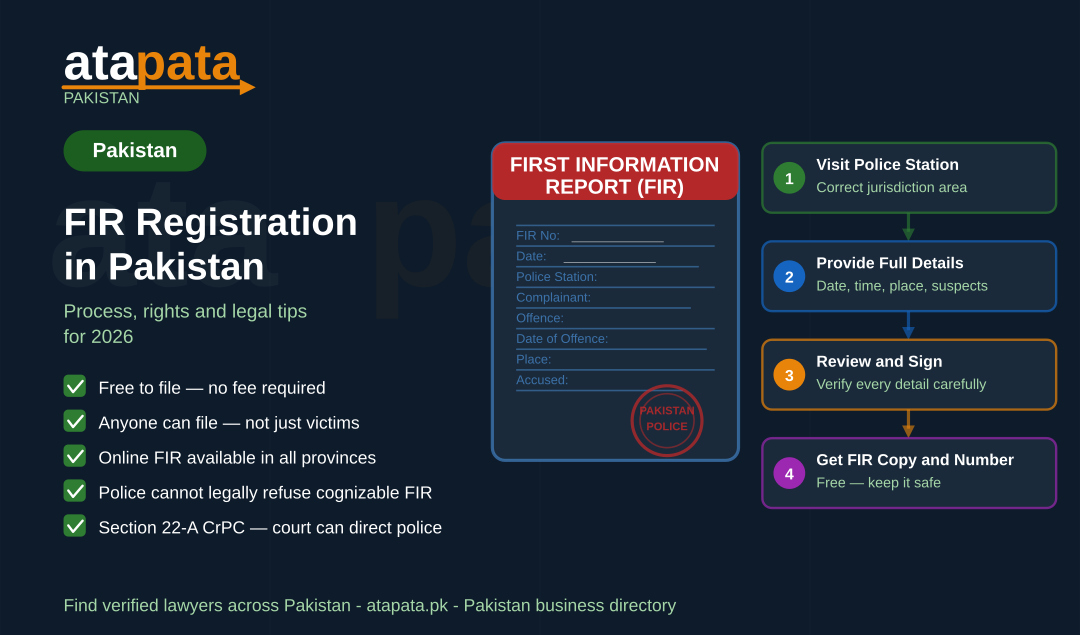
When a crime happens in Pakistan, most people panic. They do not know their rights, face police resistance or make critical mistakes that weaken their case from the very first step. A First Information Report — commonly known as an FIR — is the most important document in Pakistan's criminal justice system. Getting it right from the beginning makes all the difference between justice and endless delays.
This complete guide covers everything you need to know about FIR registration in Pakistan — what an FIR is, who can file it, the step-by-step process, online FIR options across all four provinces, your legal rights and what to do if police refuse to cooperate.
What is an FIR in Pakistan?
A First Information Report (FIR) is the official written document prepared by police when a cognizable offence is reported. Under Section 154 of the Criminal Procedure Code (CrPC), police are legally bound to register an FIR when information about a cognizable offence is provided — regardless of who provides that information or whether the accused is known or unknown.
Without an FIR, the criminal justice process in Pakistan does not formally begin. It is the foundation of every criminal case — creating an official record, triggering police investigation and protecting your legal rights from day one.
What is a Cognizable Offence?
A cognizable offence is a serious crime where police have the authority to arrest without a warrant and begin investigation without prior court permission. Common examples include murder, theft, robbery, kidnapping, rape, assault and fraud. For non-cognizable offences — less serious matters — a complaint to a magistrate is required instead of a direct FIR at the police station.
Who Can File an FIR in Pakistan?
Many Pakistanis believe only the direct victim of a crime can file an FIR. This is incorrect. Under Pakistani law, anyone with knowledge of a cognizable offence can file an FIR — including:
- The victim directly affected by the crime
- A witness who saw or has knowledge of the crime
- A relative or friend of the victim
- Any concerned citizen with knowledge of the offence
You do not need a lawyer to file an FIR. However for complex, sensitive or high-stakes cases — property disputes, family matters, cases involving powerful individuals — consulting a lawyer before filing is strongly recommended.
Step by Step Process to File an FIR in Pakistan
Step 1 — Visit the Correct Police Station
Go to the police station that has jurisdiction over the area where the crime occurred — not just the nearest police station to your home. Filing in the wrong jurisdiction can cause significant delays and complications. If you are unsure which police station has jurisdiction, call the local police helpline or ask any police officer.
Step 2 — Speak to the Duty Officer
At the police station, ask to speak with the Duty Officer or the Station House Officer (SHO). Clearly state that you want to register an FIR. Be calm and factual — do not let emotions cause you to exaggerate or omit important details.
Step 3 — Provide Complete and Accurate Details
Give the officer a clear and complete account of the incident. Include:
- The exact date, time and location of the incident
- A detailed description of what happened
- Names or physical descriptions of suspects if known
- Names and contact details of any witnesses
- Any available evidence — CCTV footage, photographs, documents, messages
Accuracy at this stage is critical. Vague or incorrect information in the FIR can be used against your case later in court.
Step 4 — Statement Recording
You may narrate the incident verbally — the officer will record it — or you may submit a written complaint. The officer must record your statement accurately in Urdu or English. Do not allow the officer to paraphrase or summarize in a way that changes the meaning of what you reported.
Step 5 — Review Carefully Before Signing
Before signing anything, ask the officer to read the FIR aloud to you. Carefully verify every detail — spelling of names, dates, times and the description of the incident. Once you are satisfied that everything is recorded accurately, sign or thumbprint the document.
You are legally entitled to receive a free copy of the FIR immediately upon registration. Always take your copy before leaving the police station.
Step 6 — Note Your FIR Number
The FIR is assigned a unique registration number. Keep this number secure — you will need it for case tracking, court proceedings and all future legal follow-ups. Take a photograph of your FIR copy as a backup.
Online FIR Registration in Pakistan
Several provinces in Pakistan now offer online FIR registration portals — a significant improvement that allows citizens to report certain types of crimes without visiting a police station. Online FIR registration is typically available for vehicle theft, lost documents, missing persons, cybercrime and property offences.
Provincial Online FIR Portals:
- Punjab Police — fir.punjabpolice.gov.pk
- KPK Police — pas.kppolice.gov.pk
- Sindh Police — igpcms.sindhpolice.gov.pk
- Balochistan Police — balochistanpolice.gov.pk
For serious violent crimes, visiting the police station in person is usually required. Online portals are most useful for property crimes, vehicle theft and cyber offences where physical evidence collection at the scene is not immediately required.
What If Police Refuse to Register Your FIR?
Police refusal to register an FIR for a cognizable offence is illegal under Pakistani law. Unfortunately it does happen — and knowing your options is essential.
Option 1 — Approach Senior Officers:
If the duty officer refuses, escalate immediately to the Station House Officer (SHO). If the SHO also refuses, go to the District Police Officer (DPO) or Senior Superintendent of Police (SSP) of your district.
Option 2 — File a Written Complaint:
Submit a written complaint to the District Police Officer clearly stating that the police station refused to register your FIR and the reasons given for refusal. Keep a copy of this complaint with a date stamp.
Option 3 — Apply Under Section 22-A CrPC:
This is one of the most powerful legal remedies available. You may file an application before the Sessions Court under Section 22-A of the Criminal Procedure Code. The court has the authority to legally direct the police to register your FIR. This option is particularly useful when police refusal appears to be influenced by corruption, political pressure or bias.
Option 4 — Contact Citizens Complaint Portals:
Most provincial police departments have citizen complaint portals and helplines where refusal to register an FIR can be reported directly to senior police leadership. Punjab Police's 15 helpline and similar services in other provinces can be effective for escalation.
Your Legal Rights After Filing an FIR
Once your FIR is registered, Pakistani law guarantees you specific rights throughout the investigation process:
- Right to a free FIR copy — you must receive a copy immediately upon registration at no cost
- Right to prompt investigation — police must begin investigation immediately after FIR registration
- Right to respectful treatment — police must treat you with dignity and respect throughout the process
- Right to follow-up information — you may request updates on the progress of your case investigation
- Right to confidentiality — particularly important in sensitive cases involving women, children or family matters
- Right to legal representation — you may consult and be accompanied by a lawyer at any stage
FIR vs Complaint — What is the Difference?
Many Pakistanis confuse an FIR with a general complaint. They are legally distinct:
- FIR — filed at a police station for cognizable offences. Triggers immediate police investigation without court direction. Police can arrest suspects without a warrant.
- Complaint — filed before a magistrate or court for non-cognizable offences or civil disputes. Police cannot act without court direction. Used for matters like minor disputes, defamation or breach of contract.
Choosing the wrong type of report can delay justice significantly. When in doubt — consult a lawyer before deciding whether to file an FIR or a complaint.
Important Legal Tips for Filing a Strong FIR
- Act quickly — file the FIR as soon as possible after the incident. Delays can raise questions about the credibility of your report and allow evidence to be lost or tampered with
- Stick to facts — avoid emotional language, exaggeration or guessing. Every word in an FIR has legal weight and will be scrutinized in court
- Do not name suspects without evidence — falsely accusing someone in an FIR can have serious legal consequences for you
- Bring documentation — bring any available evidence with you — photographs, CCTV recordings, messages, receipts or any other relevant documents
- Keep copies of everything — photograph your FIR copy, note the FIR number and keep copies of any documents you submitted
- Follow up regularly — visit or call the Investigation Officer assigned to your case regularly. Consistent follow-up prevents your case from being neglected
- Consult a lawyer for complex cases — for property disputes, family matters, cases involving powerful individuals or cases where you anticipate resistance — always consult a qualified lawyer before filing
- Do not accept verbal assurances — if police say they will "look into it" without registering an FIR, insist on formal registration. Verbal promises have no legal standing
Common Reasons FIR Registration is Delayed in Pakistan
Understanding why delays happen helps you anticipate and address them:
- Police attempting to resolve the matter informally rather than formally
- Corruption or influence from the accused party
- Classifying cognizable offences as non-cognizable to avoid workload
- Jurisdictional disputes between police stations
- Insufficient documentation presented by the complainant
In all these situations, your best response is to escalate promptly through official channels and — where possible — engage a lawyer.
Special Situations — FIR for Overseas Pakistanis
Overseas Pakistanis dealing with crimes back home — property fraud, land grabbing, family disputes — face unique challenges when trying to file an FIR from abroad. Options available include:
- Authorizing a trusted family member or lawyer in Pakistan to file the FIR on your behalf through a power of attorney
- Filing a complaint with the Overseas Pakistanis Commission which can facilitate FIR registration in certain cases
- Contacting Pakistan's Federal Investigation Agency (FIA) for crimes with cross-border elements
- Consulting a Pakistani lawyer who can file the FIR and represent your interests while you remain abroad
If you are an overseas Pakistani dealing with a legal matter back home — finding a verified lawyer in Pakistan through a reliable source is your most important first step. Browse verified lawyers across Pakistan on AtaPata — Pakistan's local business directory — to find a qualified lawyer in your city who can handle your case.
FAQs about FIR Registration in Pakistan
Is there any fee for filing an FIR in Pakistan?
No — filing an FIR in Pakistan is completely free by law. If any police officer demands payment for registering an FIR, this is corruption and should be reported to senior police officials or through citizen complaint portals.
Can police cancel my FIR?
No — police cannot cancel an FIR once it is registered. Only a court has the authority to quash or cancel an FIR. If police pressure you to withdraw your FIR, consult a lawyer immediately.
Can a minor file an FIR in Pakistan?
Yes — a minor can file an FIR with the assistance of a parent or guardian. In cases involving crimes against children, police are required to handle the matter with particular sensitivity and may involve child protection authorities.
What if I do not know the name of the suspect?
You can still file an FIR against an unknown person — described as "unknown accused" in the FIR. Provide as detailed a physical description as possible. The investigation officer will work to identify the suspect during the investigation.
How can I check the status of my FIR?
You can check FIR status through provincial police online portals, by visiting the police station where the FIR was registered, or by contacting the Investigation Officer directly using the contact details provided when the FIR was registered.
Can I file an FIR if I am not a Pakistani citizen?
Yes — foreign nationals in Pakistan have the right to file an FIR if they are victims of a crime. They may wish to also inform their country's embassy or consulate in Pakistan.
What happens after an FIR is registered?
After registration, an Investigation Officer is assigned to the case. The IO inspects the crime scene, collects evidence, records witness statements and submits a final report — called a challan — to the court upon completion of investigation. The court then proceeds with the criminal trial.
Can I file an FIR for cybercrime in Pakistan?
Yes — cybercrime FIRs can be filed at the Federal Investigation Agency's (FIA) National Response Centre for Cyber Crimes (NR3C) which has offices in major Pakistani cities including Lahore, Karachi and Islamabad. Some cybercrime cases can also be reported through provincial police online portals.
Find a Verified Lawyer in Pakistan on AtaPata
Whether you need a criminal lawyer to assist with FIR registration, a property lawyer to address land disputes or a family lawyer for sensitive personal matters — AtaPata helps you find verified lawyers across all major cities in Pakistan. Browse our Pakistan business directory to find a qualified lawyer near you with contact details, address and office hours.