In less than five years, Pakistan has undergone one of the world's most remarkable energy transformations.
A country once known for 12 to 18 hours of daily load shedding now has millions of homes, shops and factories generating their own electricity from rooftop solar panels.
Unlike most energy revolutions, this one wasn't led by the government. It was led by ordinary Pakistanis.
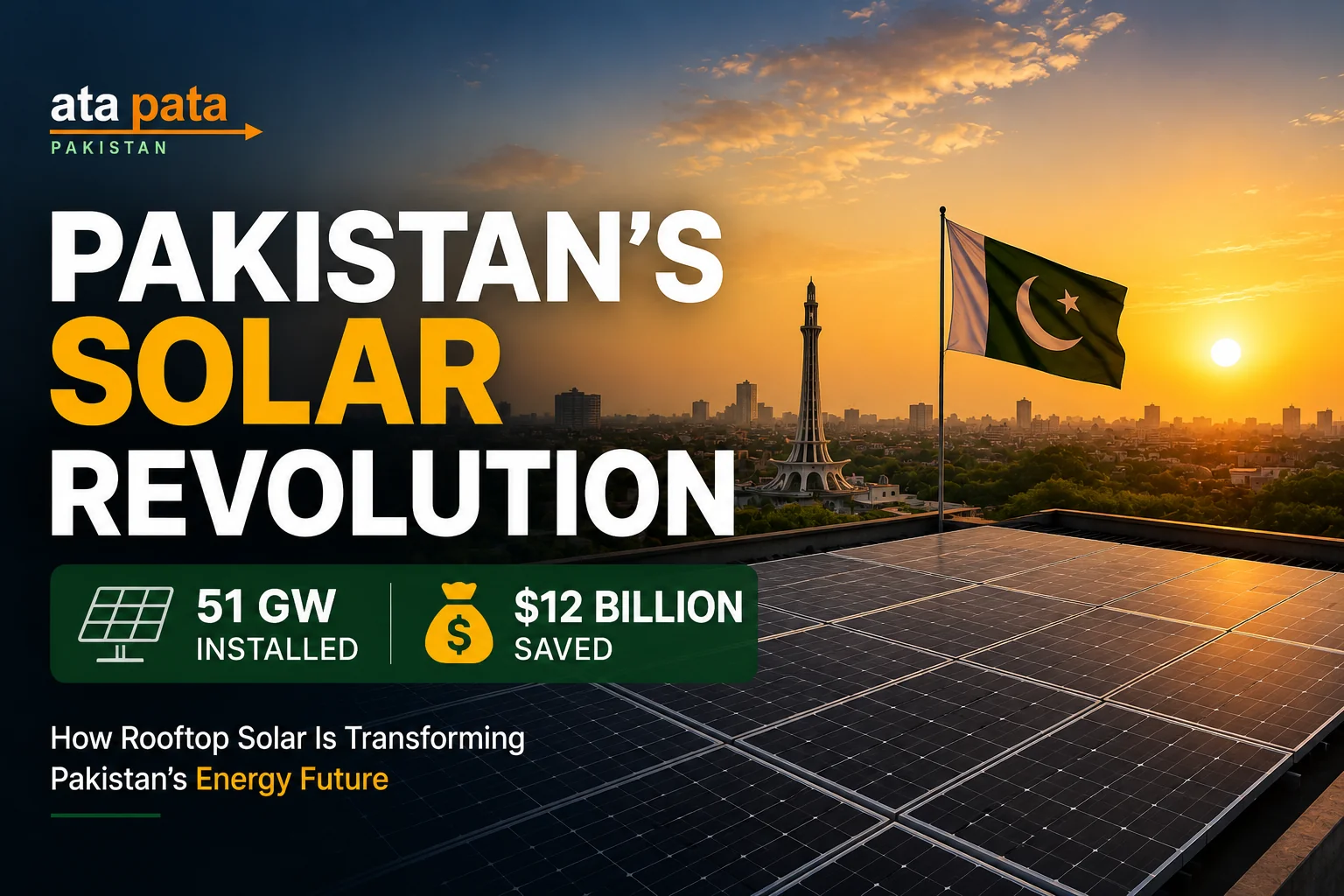
As of March 2026, Pakistan has deployed an estimated 51 gigawatts of solar capacity. Of that, 28 gigawatts comes from small rooftop installations on homes, shops and factories, making Pakistan's solar story one of the most decentralized energy revolutions in the world. Only about 1.5 gigawatts comes from large government-style solar farms. The rest is people power, literally.
How It Started
Pakistan, heavily dependent on imported gas to run its power plants, saw electricity bills spiral out of control in 2022. For millions of middle-class Pakistani families, the calculation became simple: a solar system costs money upfront, but it pays for itself in a few years and then runs essentially free. The rush to solar began.
By 2024, Pakistan had become one of the world's largest importer of solar panels, a title few would have predicted five years earlier. Chinese manufacturers flooded the market with affordable panels, and Pakistani households flooded rooftops with them. The movement was bottom-up, consumer-driven and unstoppable.
As demand for solar installations surged across Pakistan, finding reliable installers became increasingly important. AtaPata helps users discover trusted solar panel installers in major cities across Pakistan.
$12 Billion in Fuel Imports Avoided
The economic impact has been significant. An analysis by Islamabad-based Renewables First and the Centre for Research on Energy and Clean Air found that since 2020, Pakistan has avoided over $12 billion in oil and gas imports that it would otherwise have needed to meet domestic energy needs. At current energy prices, Pakistan could save a further $6.3 billion in 2026 alone.
This saving has had a real macro impact. Pakistan's LNG import demand has fallen sharply. The country has gone back to its LNG suppliers to renegotiate long-term contracts for the diversion of surplus cargoes to international markets. The same "take-or-pay" LNG contracts that were once a lifeline have now become a liability, costing Pakistan an estimated $378 million in annual losses as domestic demand for grid electricity has collapsed.
Grid Demand Is Falling
The numbers tell a striking story. Grid electricity demand dropped 10.4 percent in the 2024 financial year compared to 2022 levels. Electricity sales by distribution companies fell 3 percent between 2023 and 2024. The national grid, once the only source of power for Pakistani homes, is becoming a backup for millions of households who now generate their own electricity during the day.
Power distribution losses declined from 18.3 percent in June 2024 to 15.3 percent in March 2026, while electricity bill recovery improved to 96.46 percent — a sign that the remaining grid users are paying more reliably even as the overall user base shrinks.
A Buffer Against Global Energy Shocks
The scale of Pakistan's solar adoption has given the country an unexpected advantage in 2026. As the US-Israel war on Iran led to the closure of the Strait of Hormuz, through which 20 percent of the world's oil and gas passes, energy prices spiked globally. Pakistan, with 25 percent of its electricity already coming from rooftop solar, was largely insulated from the worst of the shock. While neighbouring countries scrambled to secure LNG supplies, Pakistan's distributed solar network kept homes and businesses powered.
In Balochistan's remote Dasht village, farmer Karim Baksh irrigates his watermelon fields using a solar-powered pump. Three years after borrowing Rs. 300,000 to install panels, he says he no longer worries about diesel prices. "As long as there is this sun, I can grow my watermelons," he told Al Jazeera. His story is replicated across millions of Pakistani households.
The Challenges Ahead
The solar revolution has not come without complications. As more wealthy households shift off the grid, the fixed capacity payments to Independent Power Producers, guaranteeing them payment whether or not their electricity is bought, must be spread across fewer remaining grid users. This has pushed tariffs higher for those who remain on the grid, creating a vicious cycle where higher tariffs push more people to solar, which pushes tariffs higher still.
NEPRA responded in February 2026 by overhauling the net metering framework, replacing the unit-for-unit net metering system with a net billing system that reduced the export buyback rate from around Rs. 25-27 per unit to approximately Rs. 11 per unit. The move triggered significant public backlash, and after intervention from Prime Minister Shehbaz Sharif, existing net metering consumers were protected under their current contracts until expiry.
The government also imposed a 10 percent sales tax on imported solar panels in Budget 2025-26, having initially proposed 18 percent before backing down under industry pressure. In Budget 2026-27, the government again considered raising the tax to 18 percent but ultimately chose not to, providing stability to a market that had already seen prices rise in anticipation of the hike.
Where Pakistan Goes From Here
Pakistan has set a target of generating 90 percent of its electricity from renewables by 2034. As of early 2026, 55 percent of the country's electricity is already being produced from renewable sources. The challenge now is not how to build more solar capacity, consumers are already doing that on their own, but how to manage the grid, the legacy power contracts, and the regulatory framework in a way that does not punish the very people who drove the revolution.
One thing is clear: Pakistan's solar revolution is no longer a future ambition. It is already reshaping the country's energy landscape, reducing fuel imports, lowering electricity costs for millions of families and creating one of the world's fastest-growing rooftop solar markets.
If you are considering going solar in Pakistan, find trusted solar panel installers near you on AtaPata
- Solar Panel Installers in Lahore
- Solar Panel Installers in Karachi
- Solar Panel Installers in Islamabad
- Solar Panel Installers in Rawalpindi
- Solar Panel Installers in Faisalabad
- Solar Panel Installers in Multan
- Solar Panel Installers in Peshawar
- Solar Panel Installers in Quetta
Planning a solar installation? Check AtaPata Pulse for the latest prices of Solar Panels, Solar Inverters, and Solar Batteries.
Solar regulations continue to evolve. For the latest NEPRA net billing rules, buyback rates and approval requirements, see our latest update.