Ask any Karachi family about their biggest household challenge and finding reliable domestic help will be near the top of the list. Whether you have just moved to a new area, returned from abroad, or your previous helper has left — the process of finding trustworthy domestic staff in Karachi can feel overwhelming.
This guide covers everything you need to know about hiring domestic help in Karachi — current rates, where to find reliable workers, what to check before hiring, and how to manage the relationship professionally.
Types of Domestic Help Available in Karachi
Karachi's domestic help market is one of the largest in Pakistan. Here are the main types of household staff available:
Full-time Maid (Kaam Wali)
A full-time maid handles general household cleaning, dusting, mopping, washing dishes, and basic household tasks. In Karachi, most full-time maids work 6 days a week with one day off — typically Sunday.
Part-time Maid
Part-time maids work for multiple households — typically spending 2-3 hours at each home per day. This is the most common arrangement in Karachi's apartment-heavy areas like Clifton, DHA, and Gulshan-e-Iqbal where families may not need full-time help.
Cook (Khaansama / Bawarchi)
A dedicated cook prepares meals for the household. In Karachi, cooks are in particularly high demand in larger households, during Ramadan, and among families where both parents work full time. Good cooks in Karachi are hard to find and highly valued.
Nanny / Baby Sitter (Aaya)
A nanny or aaya looks after young children — feeding, bathing, playing, and supervising. Karachi has a significant market for nannies particularly among working mothers and dual-income households.
Driver
A household driver handles school runs, grocery shopping, and general family transport. In Karachi where public transport is limited and traffic is challenging, a reliable family driver is considered essential by many households.
Chowkidar / Guard
A security guard or chowkidar watches over the home — particularly important in Karachi given the city's security history. Many residential areas in Karachi have shared chowkidars for the street or building.
Gardener (Mali)
A mali maintains the garden and outdoor areas. Usually part-time — visiting once or twice a week.
Live-in vs Live-out
Most domestic help in Karachi is live-out — they come to work and return home. Live-in domestic workers are less common in Karachi's urban apartments but more common in larger bungalows and houses with servant quarters.
Current Domestic Help Rates in Karachi 2026
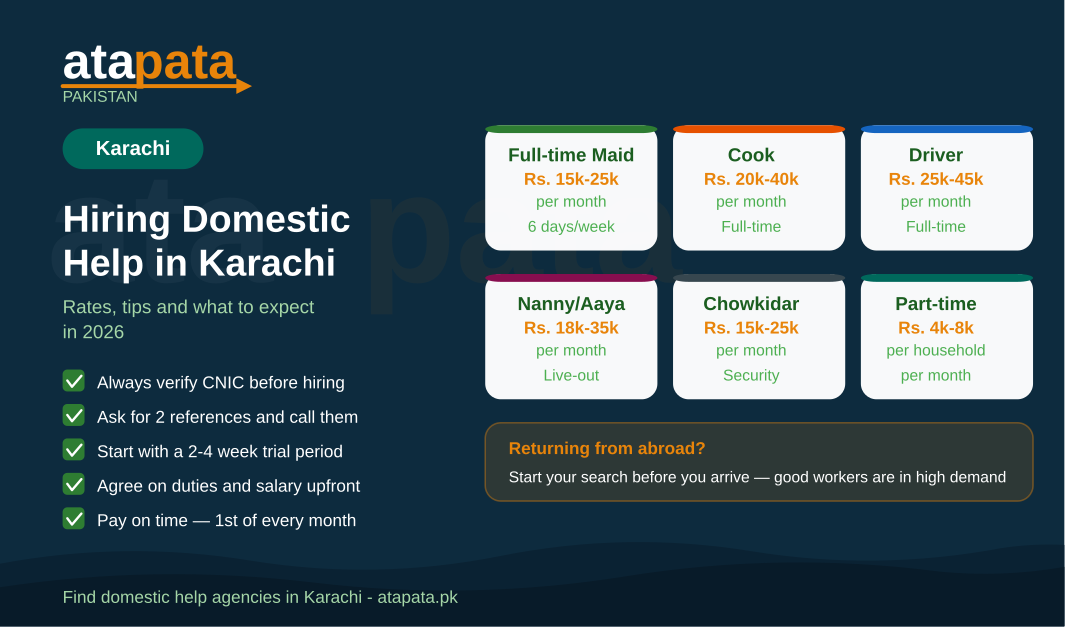
Domestic help rates in Karachi are among the highest in Pakistan. Here is a current guide to monthly salaries:
- Full-time maid (live-out) — Rs. 15,000 to Rs. 25,000 per month
- Part-time maid — Rs. 4,000 to Rs. 8,000 per household per month
- Cook (full-time) — Rs. 20,000 to Rs. 40,000 per month depending on skill level
- Nanny / Aaya — Rs. 18,000 to Rs. 35,000 per month
- Driver (full-time) — Rs. 25,000 to Rs. 45,000 per month
- Chowkidar — Rs. 15,000 to Rs. 25,000 per month
- Gardener (part-time) — Rs. 5,000 to Rs. 10,000 per month
- Live-in maid — Rs. 12,000 to Rs. 20,000 per month plus accommodation and food
Rates in premium areas like DHA, Clifton and Bahria Town Karachi tend to be 20-30% higher than the above figures. Experienced and trained workers — particularly good cooks and nannies — command premium rates regardless of area.
Where Domestic Workers in Karachi Come From
Understanding where Karachi's domestic workforce comes from helps set realistic expectations:
- Orangi Town and Baldia Town — one of Karachi's largest residential areas and a major source of domestic workers particularly maids and day workers
- Landhi and Korangi — eastern Karachi's industrial suburbs supply a significant number of domestic workers to the city's wealthier areas
- Interior Sindh — many domestic workers in Karachi migrate from Sukkur, Larkana, Khairpur and other interior Sindh cities
- KPK and Hazara — Pathan workers are common in Karachi particularly as drivers and security guards
- Bangladesh — Bangladeshi workers historically worked as domestic help in Karachi though this has reduced significantly in recent years
How to Find Domestic Help in Karachi
There are several ways to find domestic help in Karachi — each with its own advantages and risks:
Word of Mouth — Most Reliable
Asking neighbors, friends, and family for recommendations remains the most trusted method in Karachi. A worker who has been vetted by someone you trust is far safer than an unknown hire. WhatsApp neighborhood groups in areas like DHA, Clifton, and Gulshan are particularly useful for this.
Domestic Help Agencies
Karachi has numerous domestic help placement agencies — particularly concentrated in PECHS, Nazimabad, and North Karachi. A reputable agency will:
- Verify the worker's CNIC (national identity card)
- Conduct background checks
- Provide a replacement if the worker does not work out
- Handle initial salary negotiations
- Contact and Verify References
- Contact previous employer directly
Agency fees in Karachi typically range from one month's salary to Rs. 5,000-10,000 as a placement fee. Always ask for the worker's CNIC copy from the agency and verify it independently.
Online Platforms and Apps
Several online platforms now connect households with domestic workers in Karachi. These platforms typically offer background-verified workers and handle payment and scheduling. They are more expensive than direct hires but offer more security and convenience — particularly useful for families new to Karachi or returning from abroad.
AtaPata
Browse domestic help agencies and services across Karachi on AtaPata — with contact details, addresses and service information all in one place.
Essential Checks Before Hiring Domestic Help in Karachi
Karachi's size and complexity make proper vetting more important than in smaller cities. Never skip these steps:
CNIC Verification
Always ask for a copy of the worker's Computerised National Identity Card (CNIC). Verify it is genuine by checking the NADRA verification service — SMS the CNIC number to 7000 or verify online at nadra.gov.pk. A worker who refuses to provide their CNIC is a red flag.
References
Ask for references from at least two previous employers and actually call them. Ask specifically about honesty, reliability, and whether they would hire the person again. Most genuine workers will have references readily available.
Trial Period
Always start with a trial period of 2-4 weeks before committing to a permanent arrangement. During the trial period assess reliability, work quality, behavior with children if applicable, and overall trustworthiness.
Local Address Verification
Confirm the worker's home address in Karachi. A worker with a verifiable local address in a known area provides an additional layer of accountability.
Police Verification
For live-in workers or those with access to sensitive areas of your home — particularly in Karachi — police verification is strongly recommended. Contact your local police station for the process. Some agencies provide this as part of their service.
Setting Up the Working Relationship
A clear professional arrangement from day one prevents misunderstandings and protects both parties:
Agree on duties clearly
Be specific about exactly what tasks are expected — which rooms, which days, whether cooking is included, whether childcare is expected. Vague arrangements lead to disputes.
Agree on salary and payment date
Agree on a fixed monthly salary and a specific payment date — the 1st of every month is standard. Pay on time consistently — late payment is one of the most common reasons good workers leave.
Agree on off days and holidays
Most Karachi domestic workers expect Sunday off and paid holidays on Eid ul Fitr, Eid ul Adha, and other major public holidays. Clarity on this upfront prevents tension.
Annual bonus (Eidi)
It is standard practice in Karachi to give domestic workers an Eidi equivalent to one month's salary on Eid ul Fitr. Workers expect this and it is an important part of maintaining a good working relationship.
Advance requests
Domestic workers in Karachi frequently request salary advances for emergencies, medical expenses, or family events. Establish a clear policy on advances from the start — whether you will give them, up to what amount, and how they will be deducted.
Special Considerations for Overseas Pakistanis Returning to Karachi
If you are returning to Karachi from abroad — UK, USA, UAE, Saudi Arabia, or elsewhere — finding domestic help will likely be one of your first priorities. Here is what to expect:
- Rates have increased significantly — domestic help in Karachi costs 2-3x more than it did 5-10 years ago. Budget accordingly
- Good workers are in high demand — don't be surprised if promising candidates are already committed elsewhere. Start your search before you arrive if possible
- Use your network immediately — reach out to family and friends in Karachi before arriving and ask them to start asking around. Word of mouth works faster than agencies
- Expect an adjustment period — workers unfamiliar with families returning from abroad may need time to understand your expectations and preferences
- Be patient with different standards — what passes for clean or well-cooked in Karachi may differ from what you have been used to abroad. Communicate expectations clearly and patiently
Common Mistakes to Avoid
- Hiring without CNIC verification — never skip this in Karachi regardless of how trusted the referral source
- Not having a trial period — a worker can seem perfect in an interview and completely different in practice
- Paying above market rates immediately — start at the standard rate and increase based on performance. Starting too high makes it difficult to adjust later
- Not setting clear expectations — assuming the worker knows what you want without telling them leads to constant frustration
- Ignoring small dishonesty early on — small issues ignored early tend to become bigger problems later
- Not paying on time — consistent late payment is the fastest way to lose a good worker in Karachi's competitive domestic help market
Legal Obligations for Domestic Employers in Pakistan
Pakistan has limited formal regulation of domestic employment but there are some obligations worth knowing:
- Domestic workers are entitled to one day off per week
- Workers should be paid at least the minimum wage — though domestic workers are often outside formal minimum wage enforcement
- Treat domestic workers with dignity and respect — physical or verbal abuse is illegal
- Provide reasonable working hours — extremely long working days are both unethical and counterproductive
Find Domestic Help Services in Karachi on AtaPata
Browse domestic help agencies and placement services across Karachi on AtaPata — with contact details, addresses and service information.