Pakistan Introduces Daily Petrol Price Updates: What Changed and How It Affects Consumers & Businesses
Pakistan has replaced its twice-monthly fuel pricing system with daily petrol and diesel price revisions. Learn how the new pricing mechanism works, the latest fuel prices, and how rising fuel costs affect consumers, transport operators, delivery services and businesses across Pakistan.
⚡ Key Points
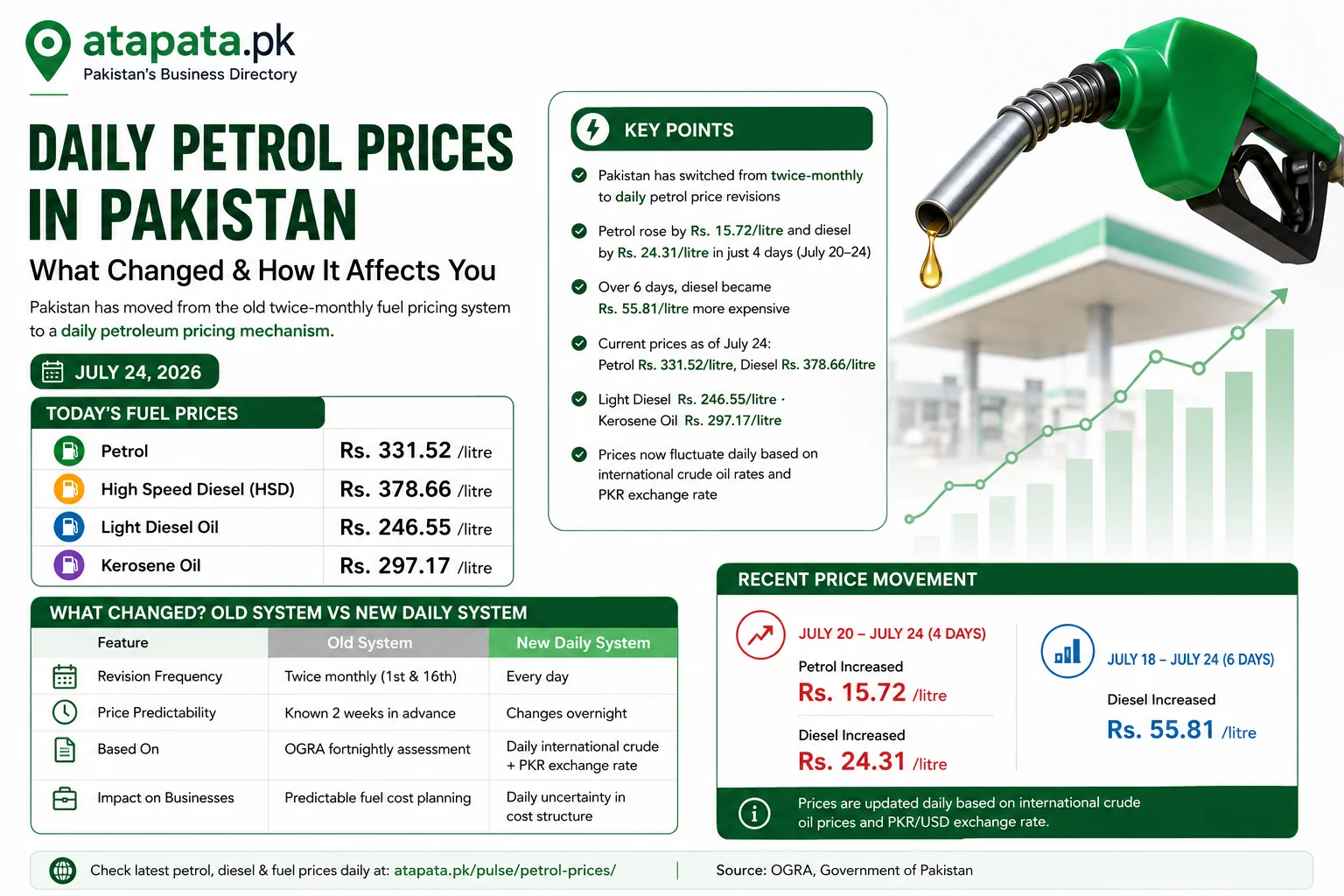
- Pakistan has shifted from twice-monthly to daily petrol and diesel price revisions.
- Between July 20 and July 24, petrol increased by Rs. 15.72/litre and diesel by Rs. 24.31/litre.
- Within just six days, diesel prices climbed by Rs. 55.81/litre.
- As of July 24, 2026, petrol costs Rs. 331.52/litre while high-speed diesel costs Rs. 378.66/litre.
- Light Diesel Oil is priced at Rs. 246.55/litre, while Kerosene Oil costs Rs. 297.17/litre.
- Fuel prices now change daily based on international crude oil prices and the Pakistani Rupee (PKR) exchange rate.
Pakistan's fuel pricing mechanism has fundamentally changed. Instead of revising petrol and diesel prices twice a month, traditionally on the 1st and 16th, the government has introduced a daily petroleum pricing mechanism linked directly to international crude oil prices and the PKR/USD exchange rate.
For consumers, businesses and transport operators, this means petrol and diesel prices can now increase or decrease every day, sometimes by significant amounts, making fuel costs far more dynamic than before.
What Changed? Old System vs Daily Fuel Pricing
Until July 2026, petrol and diesel prices in Pakistan were revised only twice a month, usually on the 1st and 16th. Under the new mechanism, fuel prices can now be updated every day based on international crude oil prices and the Pakistani Rupee's exchange rate.
| Feature | Previous System | New Daily System |
|---|---|---|
| Price Updates | Twice a month (1st & 16th) | Can change every day |
| Price Basis | Fortnightly OGRA assessment | International oil prices + PKR/USD exchange rate |
| Predictability | Stable for about two weeks | Prices may change overnight |
| Impact on Consumers | Easier budgeting and trip planning | Need to monitor prices more frequently |
| Impact on Businesses | More predictable fuel and transport costs | Daily fluctuations affect transport, logistics and operating costs |
Impact on Transport & Service Businesses
The shift to daily fuel price revisions affects almost every transport-dependent business in Pakistan. Rising petrol and diesel costs increase operating expenses, forcing many service providers to revise their pricing more frequently than before.
Car Rental Services
Car rental companies are among the businesses most affected by daily fuel price fluctuations. Operators offering fixed daily, weekly or monthly rental packages now face unpredictable operating costs, particularly for intercity travel where fuel accounts for a large share of expenses. Many businesses are expected to introduce fuel adjustment clauses or review rental rates more frequently.
Movers & Packers
Diesel prices have increased dramatically in recent days, placing additional pressure on movers and packers. A truck travelling between Lahore and Karachi typically consumes around 200–250 litres of diesel. With diesel becoming more than Rs. 50 per litre costlier within a week, the fuel expense for a single trip can increase by over Rs. 10,000. These higher operating costs are likely to be reflected in moving charges.
Drivers & Taxi Services
Taxi and driver services also face higher operating costs. Drivers using petrol-powered vehicles now spend considerably more on fuel, while even CNG operators experience indirect pressure as demand shifts between fuel types. Ride-hailing services and private transport providers may gradually increase fares to offset the rising cost of daily operations.
Wedding Halls & Event Services
Wedding halls and event venues that provide transportation, logistics or diesel-powered backup generators are also affected. Higher diesel prices increase the cost of guest transport, decoration delivery and electricity backup during load shedding. Businesses offering fixed-price event packages may experience shrinking profit margins if fuel prices continue to change daily.
Car Services & Auto Workshops
Car service centres and auto workshops experience both challenges and opportunities. As fuel becomes more expensive, many vehicle owners postpone non-essential maintenance to reduce expenses. At the same time, demand for fuel-efficiency tuning, engine diagnostics, injector cleaning and other services that improve mileage often increases as motorists look for ways to reduce fuel consumption.
Overall Economic Impact
Daily petroleum price revisions make business planning more difficult for transport-intensive industries. Companies can no longer rely on fuel prices remaining stable for two weeks, requiring more frequent pricing reviews, tighter cost management and greater flexibility in customer contracts. Businesses with large vehicle fleets are expected to feel the greatest impact from the new pricing system.
What Should You Do?
- Check prices before filling up, prices now change daily so the rate this morning may differ from the evening
- Business owners, review contracts and quotations that include fuel costs and add a fuel surcharge clause if needed
- Intercity travelers, factor in higher toll charges (NHA revised rates from July 10) alongside rising fuel costs for total trip cost
- Track daily petrol prices on AtaPata Pulse, we update petrol and diesel prices daily
Final Thoughts
The introduction of daily petrol and diesel price revisions marks one of the biggest changes to Pakistan's fuel pricing system in recent years. While the new mechanism allows local fuel prices to reflect international oil markets more quickly, it also introduces greater uncertainty for consumers and businesses that depend on transportation.
For businesses such as car rentals, movers and packers, taxi operators, delivery companies and event services, fuel has become a cost that must be monitored every day rather than every two weeks. Consumers may also notice more frequent changes in transportation fares, delivery charges and the prices of goods that rely on road transport.
To help individuals and businesses make informed decisions, AtaPata Pulse continuously tracks the latest petrol, diesel and solar energy prices across Pakistan. Bookmark this page to stay updated with the latest fuel price changes and market trends.